
Dog Feeding Guide: How Much Should You Feed Your Dog?
How much should you feed your dog? This guide covers portions by weight and age, feeding frequency, how to read food labels, and signs you're getting it right.
PUPPY CARE
Pup Care and Training
6/21/202610 min read
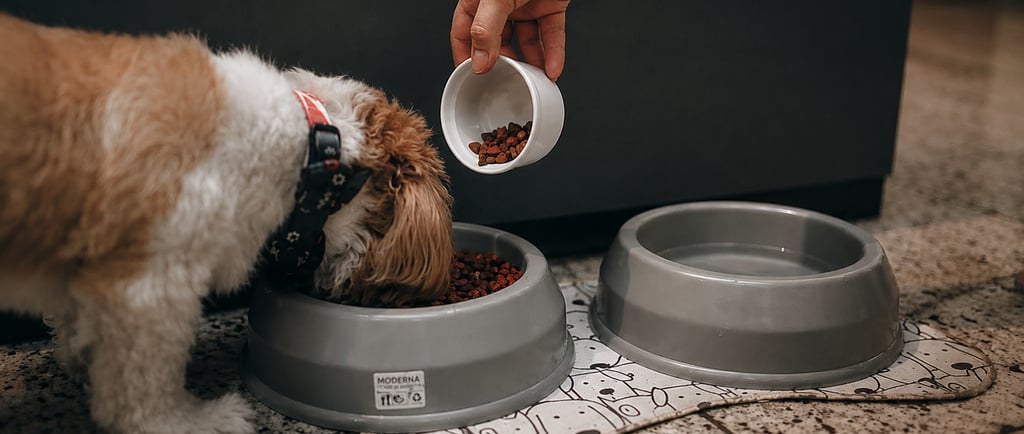
It sounds like it should be simple. Your dog needs food. You give them food. Done.
But walk into any pet shop and stare at 50 different brands with 50 different portion charts, each with different measurements for different weights and life stages - and suddenly "how much should I feed my dog" becomes genuinely confusing.
The truth is, there's no single correct answer that works for every dog. But there are clear principles that, once you understand them, make feeding your dog confidently very straightforward.
This guide covers everything - portions, frequency, life stages, body condition, and how to tell whether what you're doing is actually working.
Why Feeding the Right Amount Matters
Overfeeding is one of the most common - and harmful - things dog owners do without realising it. Studies consistently show that more than half of dogs in the UK and US are overweight or obese. Excess weight puts strain on joints, increases the risk of diabetes, heart disease, and certain cancers, reduces life expectancy, and significantly impacts quality of life.
Underfeeding, on the other hand, leads to nutritional deficiencies, muscle loss, low energy, and in growing puppies can cause developmental problems that last a lifetime.
Getting the amount right isn't fussiness - it's one of the most fundamental ways you care for your dog's long-term health.
The Starting Point: Feeding Guidelines on the Packaging
Every complete dog food comes with feeding guidelines on the bag or tin - usually a chart that recommends a daily amount based on your dog's weight. This is your starting point, but it's not the final word.
Here's why: those guidelines are averages, calculated for a typical dog at a typical activity level. Your dog is not average. They're a specific age, breed, size, activity level, and body type. The packaging guideline might be exactly right, slightly too much, or slightly too little for your individual dog.
Use the packaging guide to get into the right ballpark. Then use your dog's body condition - which we'll cover in detail below - to fine-tune from there.
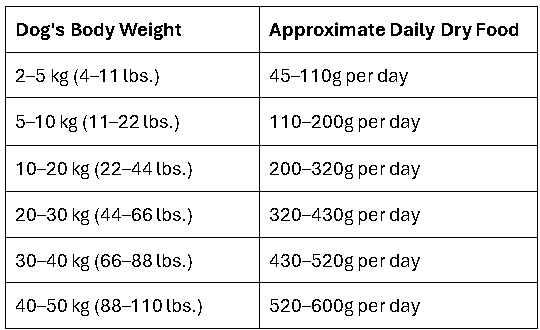
Dog Feeding Chart by Weight: A General Guide
Since most food packaging uses similar calculations, here's a rough reference guide for daily dry food portions based on your dog's weight. Always check the specific food you're using, as caloric density varies between brands.
These are broad averages for moderately active adult dogs on a standard dry food. Active dogs may need 20–30% more. Less active or older dogs may need 20% less. Always adjust based on your individual dog and their body condition.
Feeding by Life Stage: Puppies, Adults, and Seniors
One of the most important variables in dog feeding is life stage. Puppies, adult dogs, and seniors have very different nutritional needs - and using the wrong food or the wrong portions for the stage your dog is in creates real problems.
Puppies
Puppies are growing fast. They need significantly more calories and specific nutrients - including higher levels of protein, calcium, and phosphorus - than adult dogs to support healthy bone, muscle, and organ development.
Always feed a food specifically formulated for puppies or "all life stages," not adult dog food. The nutritional profiles are genuinely different, and feeding an adult formula to a growing puppy can lead to developmental deficiencies.
How much to feed a puppy:
Puppy portions are typically larger relative to body weight than adult portions because of their higher energy demands. Packaging on puppy food will usually indicate portions by both age and weight - follow these and review them every two to four weeks as your puppy grows rapidly.
How often to feed a puppy:
8 to 12 weeks: 4 meals per day
3 to 6 months: 3 meals per day
6 to 12 months: 2 meals per day
Splitting daily food into multiple smaller meals matters for puppies because their small stomachs can't accommodate large amounts at once, and they need consistent fuel to support the enormous metabolic demands of growth.
Adult Dogs
Once your dog reaches adulthood - typically around 12 months for small breeds and up to 18 to 24 months for large and giant breeds - switch to an adult formula and adjust portions accordingly.
How often to feed an adult dog:
Twice daily - morning and evening - is the standard recommendation for most adult dogs. This keeps blood sugar stable throughout the day, supports digestion, and makes it easy to monitor appetite and food intake. Once-daily feeding is practised by some owners but can lead to digestive issues, bloating risk in larger breeds, and longer periods of hunger.
Some owners prefer three meals a day, particularly for smaller breeds or dogs who struggle with hunger between meals. This is perfectly fine - just divide the daily total across three meals rather than two.
Free feeding - leaving food out all day - is generally not recommended. It makes it nearly impossible to monitor how much your dog is eating, encourages overeating in most dogs, and makes it harder to spot appetite changes that might signal a health issue.
Senior Dogs
Dogs are generally considered senior from around seven years old, though this varies significantly by size - large breeds age faster and are often classed as senior from five or six.
Senior dogs typically need fewer calories because their metabolism slows and activity levels reduce. However, they still need high-quality protein to maintain muscle mass - which tends to decline with age - and may benefit from food formulated with joint support, fibre for digestive health, and reduced phosphorus for kidney health.
Many senior dogs do well continuing on their adult food in reduced amounts. Others benefit from a specific senior formula. Your vet is the best person to advise based on your dog's individual health picture.
Feed senior dogs twice daily and weigh them regularly - weight loss in older dogs is often the first sign of an underlying health issue worth investigating.
How to Read a Dog Food Label
The packaging guideline is the starting point - but to use it correctly, you need to understand what you're working with.
Check the caloric content. Dog foods can vary dramatically in caloric density. A cup of one brand might contain 300 calories; a cup of another might contain 500. If you switch foods without adjusting portions, your dog could be getting significantly more or fewer calories overnight.
Look at the feeding guidelines carefully. Most dry foods are measured in grams, not cups - and weighing food is significantly more accurate than using a cup measure, which can vary by 20–30% depending on how it's filled. Use kitchen scales. It takes 10 extra seconds and makes a real difference.
Understand that guidelines are for the total daily amount. If your dog gets two meals a day, divide the daily guideline in half for each meal. This sounds obvious - but it's a surprisingly common source of overfeeding when owners give the full recommended daily amount at each meal.
Factor in treats. Treats have calories too - and most owners significantly underestimate how much they add up. High-treat days mean the main meal portions should reduce slightly. As a general rule, treats should make up no more than 10% of your dog's daily caloric intake.
The Body Condition Score: The Most Reliable Feeding Check
Forget the feeding chart for a moment. The single most accurate way to know whether you're feeding your dog the right amount is the body condition score (BCS) - a simple, hands-on assessment that tells you more than any number on a bag.
Here's how to assess it:
Run your hands along your dog's ribcage. You should be able to feel each individual rib clearly without pressing hard - but you shouldn't be able to see the ribs visibly. If you have to press firmly to feel them, your dog is likely carrying too much weight. If the ribs are visibly protruding, your dog may be underweight.
Look at your dog from above. There should be a visible waist - a narrowing behind the ribs. A dog without a discernible waist when viewed from above is likely overweight.
Look at your dog from the side. The abdomen should tuck up slightly behind the ribs. A dog whose belly hangs level or drops below the ribline is likely overweight.
Check the hip bones. You should be able to feel them but not see them easily. Visible, prominent hip bones suggest your dog is too thin.
The body condition score runs from 1 (severely underweight) to 9 (severely obese), with 4–5 considered ideal. Many vets will do a BCS assessment at routine appointments - ask them to show you where your dog sits and what to aim for.
How to Adjust Portions Based on Body Condition
Once you've assessed your dog's body condition, here's how to act on it:
If your dog is overweight: Reduce daily portions by approximately 10%. Reassess body condition after two to four weeks. If no change, reduce by another 10%. Continue gradually. Avoid crash dieting - rapid weight loss in dogs causes muscle loss alongside fat loss.
If your dog is underweight: Increase daily portions by 10%. Reassess after two to four weeks. If still losing or not gaining, increase by another 10% and consider a vet check to rule out underlying health issues.
If your dog is at ideal weight: You've found the right amount. Keep doing what you're doing, but reassess every few months as activity levels and metabolism can change with age and season.
Factors That Affect How Much Your Dog Needs
Beyond weight and life stage, several other factors influence how much your individual dog needs:
Activity level. A working dog, a dog who runs with their owner daily, or a dog who competes in agility needs significantly more calories than a dog who takes two short lead walks a day. Active dogs may need 20 to 40% more than the packaging guideline suggests.
Breed. Some breeds have faster metabolisms than others. Smaller breeds typically burn more calories relative to their body weight than larger breeds. Greyhounds and sight hounds often need more food than their slim frames suggest. Labradors and Cavaliers are particularly prone to weight gain and may need careful portion control.
Reproductive status. Intact females go through hormonal cycles that can affect appetite and metabolism. Pregnant or nursing dogs have dramatically higher caloric needs -a nursing dog may need two to four times her normal daily intake depending on litter size. Spayed and neutered dogs often have slightly lower caloric needs than intact dogs.
Season and temperature. Dogs who spend a lot of time outdoors in cold weather burn more calories maintaining body temperature. Very hot weather often reduces appetite. Some seasonal adjustment to portions is normal.
Health conditions. Certain conditions - thyroid disease, diabetes, Cushing's disease, kidney disease, and others - significantly affect how dogs process and need food. If your dog has a diagnosed health condition, their feeding plan should be discussed with your vet.
Wet Food, Dry Food, or Both?
Many owners feed a combination of wet and dry food - and that's perfectly fine. But the caloric calculations need to account for both.
Dry food (kibble) is calorie-dense and convenient. It's typically 3–4 calories per gram, easy to measure, and supports dental health through the mechanical action of chewing.
Wet food has much higher water content - usually around 70–80% water - which makes it less calorie-dense per gram. Dogs often find it more palatable, and the higher water content supports hydration, which is particularly beneficial for dogs who don't drink enough or who have kidney issues.
If you're mixing wet and dry, reduce the dry food portion proportionally to account for the calories in the wet food. Most wet food tins include a guideline for use as a complete diet - use this to calculate what percentage of the daily intake the wet food provides and reduce the dry food accordingly.
Practical Tips for Getting Feeding Right
Weigh the food rather than measuring by cup. Measuring cups are inaccurate - a cup of kibble can weigh anything from 85g to 130g depending on the kibble size and how the cup is filled. Kitchen scales give you a consistent, accurate measure every time.
Feed at consistent times each day. Regular mealtimes keep your dog's digestive system working optimally, help regulate appetite, and make it much easier to spot when their appetite changes - which is often an early sign of illness.
Always provide fresh water. Hydration is as important as nutrition. Clean and refill the water bowl daily. Dogs on dry food diets especially need constant access to fresh water.
Don't use the bowl as a substitute for attention. A lot of overfeeding happens because giving food feels like giving love. It is - but in excess it's a form of harm. Play, exercise, training, and your time are all forms of love that don't carry the health risks of extra calories.
Review portions regularly. Your dog's needs change over time. A puppy becoming an adult, a dog becoming less active with age, seasonal changes, a change in food brand - all of these require a portion review. Build in a body condition check every one to two months.
When to Talk to Your Vet About Feeding
Most healthy dogs do well on a quality complete food in the right amount, fed twice daily. But speak to your vet if:
Your dog is losing or gaining weight despite what seems like appropriate feeding
You have a dog with a specific health condition that affects digestion or nutrient absorption
You're feeding a homemade or raw diet - these require careful nutritional balancing to ensure completeness
You're unsure about the right food or portions for a pregnant or nursing dog
Your puppy isn't growing or gaining weight as expected
Your senior dog's appetite or weight has changed significantly
A veterinary nutritional consultation is available at most practices and can be incredibly valuable for dogs with complex needs or health conditions.
Final Thoughts
Feeding your dog well isn't about following the number on the bag perfectly. It's about understanding your individual dog - their size, age, activity level, and body condition - and adjusting as those things change over time.
Weigh the food. Feed twice daily. Check the body condition regularly. Adjust when needed. And when in doubt, ask your vet.
Get the feeding right and you give your dog one of the most fundamental gifts you can: a healthy body that supports a long, active, comfortable life with you.
Frequently Asked Questions
How do I know if I'm feeding my dog too much?
Check their body condition. If you can't feel their ribs without pressing quite firmly, if there's no visible waist from above, or if their abdomen doesn't tuck up behind the ribs when viewed from the side - your dog is likely carrying excess weight and portions should be reduced.
How often should I feed my dog?
Twice daily is the standard recommendation for most adult dogs - once in the morning and once in the evening. Puppies need more frequent meals: four times daily up to 12 weeks, three times daily from 3 to 6 months, then transitioning to twice daily from around 6 months.
Are feeding guidelines on dog food packaging accurate?
They're a reasonable starting point, but they're averages calculated for a typical dog. Your dog's individual metabolism, activity level, breed, and body condition all affect how much they actually need. Use the packaging as a guide and fine-tune based on your dog's body condition over time.
Can I mix wet and dry dog food?
Yes - many owners do this successfully. Just account for the calories in both when calculating daily portions, reducing the dry food amount proportionally to avoid overfeeding.
How do I switch my dog to a new food?
Switch gradually over seven to ten days. Mix increasing amounts of the new food with decreasing amounts of the old food - starting at around 25% new / 75% old and working up to 100% new. Sudden food switches cause digestive upset in most dogs.
Contact
We're here to help with puppy questions.
© 2025. All rights reserved.